Small steps, big impact I recently served a Bay County family through our Family Team Meeting (FTM) program. The referral came in as considered removal. The single mother had three young children and experienced needs of mental health and housing concerns. I...
Two changed lives
I received a referral in October of 2023 for a father and his son. At the first contact with the caseworker, I discovered the child had been in foster care, at this point, for almost 15 months. The case was originally opened due to the mother’s neglect and drug...Persistence Pays
My job as a YIT specialist allows me to meet the youth (ages 14-23) where they are and walk with them on their journey to adulthood. One youth in our program is an 18 year old boy. When I met with him, he did not talk much, but wanted to go to the mall. We walked...Another Adoption
I had the pleasure of being the adoption worker for a 5-year-old several years ago. This child had experienced significant abuse and neglect before coming into foster care. As a result of that trauma, she needed additional mental health treatment to help regulate...
Giving Parent as Teachers a try made all the difference
When reaching out they stated they had just started a parent education program with another agency and did not see the point of doing two different services. The client stated she was going to call her foster care worker to get clarification and would call me back the...
I just want to do right by my grandson
I worked with a grandfather who took his grandchild in to raise him. As I worked with him, I learned the grandfather had very old school way of discipline which are frowned upon in today’s age. At intake, I witnessed a situation that made me realized that there...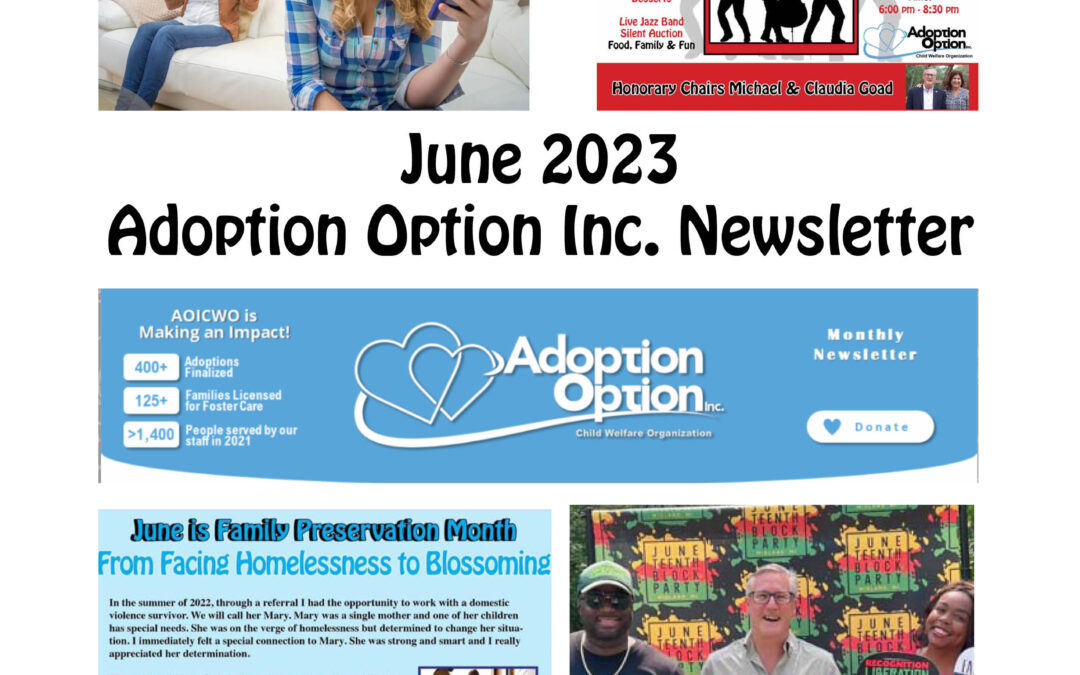
June 2023 Adoption Option Inc. Newsletter
Family Reunification Month To sign up for our Newsletter Click Here:...
May 2023 Adoption Option Inc. Newsletter
Foster Care Awareness Month To Sign Up for the Newsletter Click Here: https://conta.cc/3Dbx9lQ
April 2023 Adoption Option Inc. Newsletter
National Child Abuse Awareness & Prevention Month To sign up for our Newsletter Click Here: https://conta.cc/3DbI7HT
March 2023 Adoption Option Inc Newsletter
Happy Social Work & Women’s History Month To Sign Up for Newsletter Click Here: https://conta.cc/3DdxnZBAdoption Option Inc. Facebook Feed

April is Child Abuse Prevention Month. Here are 7 Positive Childhood Experiences that are statistically linked to good emotional and mental health in adults. ![]()
![]() 1 Being able to share their feelings with Family
1 Being able to share their feelings with Family ![]() 2 Feeling Supported by Family during difficult times
2 Feeling Supported by Family during difficult times![]() 3 Enjoying Participation in Community Traditions
3 Enjoying Participation in Community Traditions![]() 4 Feeling a sense of belonging while in high school
4 Feeling a sense of belonging while in high school ![]() 5 Feeling supported by friends
5 Feeling supported by friends![]() 6 Having at least two non-parent adults who genuinely care
6 Having at least two non-parent adults who genuinely care![]() 7 Feeling Safe and protected by and Adult at Home
7 Feeling Safe and protected by and Adult at Home
Give Local Midland is 2 weeks and Adoption Option Inc. is so excited to once again participate. To donate go to www.givelocalmidland.org/organizations/adoption-option-inc on May 7, from 12:00 am to 11:59 pm. All donations this day are online!
Need some fun activities to do with your child(ren) as spring sets in. Check out this calendar of activities that you can do. Pick one a day or take a day and do a few! Enjoy!
